
Business
Mobility
Drivetrain · Motor
Stator motors are core driving components that secure windings to enclose the rotor.
Hairpin motors represent next-generation technology, achieving high power output and superior efficiency through the precise insertion and welding of copper conductors.
Hairpin motors represent next-generation technology, achieving high power output and superior efficiency through the precise insertion and welding of copper conductors.
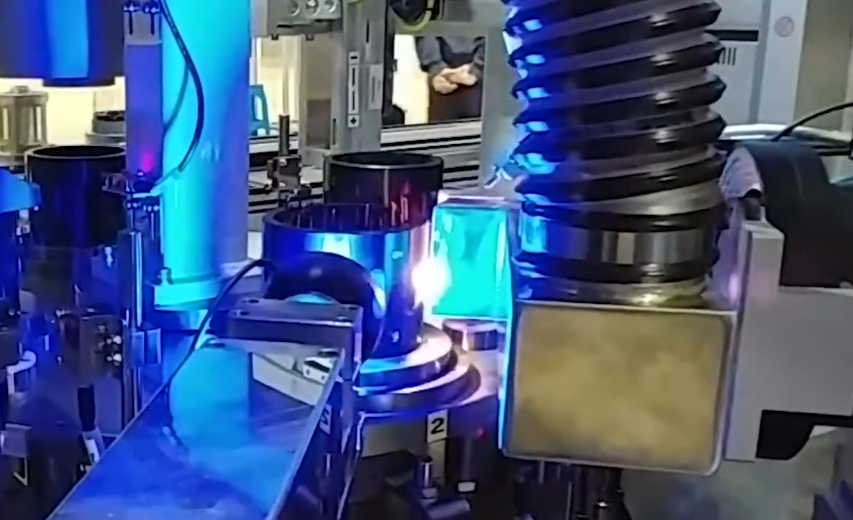
Key Processes: Drivetrain · Motor Lines
Hairpin Welding
Precision welding of copper winding ends completes the motor's electrical circuit.
- Ultra-precise Positioning: Tracks hundreds of hairpin ends via vision integration
- Uniform Bead Formation: Consistent heat control achieves uniform melting
- Minimized Spatter: Maintains clean surfaces to prevent shorts and contamination
Core Lamination Welding
Side welding of stacked steel sheets provides structural rigidity to the stator core.
- High-Strength Penetration: Robust seams prevent separation of laminated sheets
- Minimized Magnetic Loss: Suppresses deformation to maintain motor efficiency
- High-Speed Processing: Rapidly joins large cores to reduce cycle times
Housing Marking
Engraving ID on motor housings ensures manufacturing history and traceability.
- High-Contrast Marking: Durable visibility through cleaning and post-processing
- Curved Surface Marking: Distortion-free precision along cylindrical curves
- MES Integration: Automatic serial numbering linked with manufacturing systems
Process Map: Drivetrain · Motor Lines
Welding
- Exterior Assembly (steel)
- HairPin (Copper)
Marking
- Exterior (Steel)
- Housing
Removal
- Enamel Removal



INLaser Co., Ltd.
- Head Office [14449] #202-701~704, Bucheon Technopark Ssangyong 3 cha, 397, Seockcheon-ro, Bucheon-si, Gyeonggi-do, Republic of Korea
- Dongtan Branch [18468] #312~313, Dongtan woominewv, 121, Dongtan-daero 23-gil, Hwaseong-si, Gyeonggi-do, Republic of Korea
- TEL +82-32-715-5690
- FAX +82-32-715-5694
- Business Registration Number 130-86-51804
TOP
Copyright © 2025 INLASER. All Rights Reserved.
Desigend by Website.co.kr